
Vous êtes ici : Accueil
Le 05 mai 2026 De 17:00 à 19:00
Séminaire "Artistry@work" (05/05/2026)
Publié le 4 mai 2026 – Mis à jour le 27 mai 2026
Complément date
17h - 19h (4.00-6.00pm (BST))
Séminaire dans le cadre du Cycle de séminaires en ligne organisé par Raphaël Blanchier et Trevor Marchand
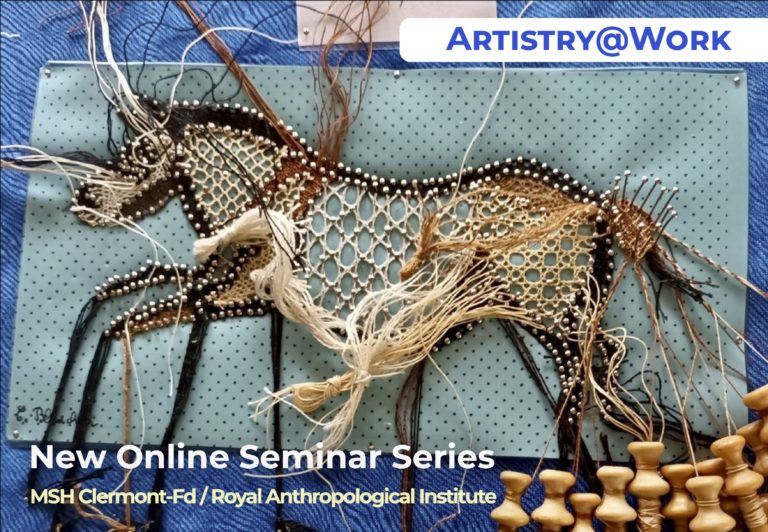
Pour la deuxième année, Raphaël Blanchier et Trevor Marchand organisent un cycle de séminaires en ligne "Artistry@work", dédié au travail, aux carrières et valeurs artistiques des artistes et artisans, co-porté par le Royal Anthropological Institute et la MSH-Clermont-Ferrand.
Plus d'informations ici.
Le prochain, et dernier, séminaire aura lieu le 5 mai 2026 de 17h à 19h (4.00-6.00pm (BST)), en ligne, avec l'intervention de Raphaël Blanchier intitulée "Lives of Talent: an ethnography of dancers’ work/life in Mongolia". Cassis Kilian sera la discutante.
L'inscription est gratuite mais obligatoire : https://us02web.zoom.us/webinar/register/WN_VrjHFAS2SmaANh7ISeCrhA#/registration
Grounded in an immersive style of ethnographic fieldwork among Mongolian dancers, as well as in comprehensive interviews and self-learning, this presentation discusses a position endorsed by French sociologists according to which “talent”, or its correlate “vocation” should be seen as a deceitful notion crafted to exploit artists in a capitalistic world. I argue that “artistic work” should be considered as something more than mere “work” in itself and, consequently, that the notion of “artistry” merits closer anthropological examination.
Raphaël Blanchier is an associate professor in the anthropology of dance (Université Clermont Auvergne, ACTé Research Center), and associate researcher at IFRAE-CNRS Research Center, and at LESC-CREM. Trained in social anthropology, dance studies and humanities, he conducts research on Mongolian dances, cultural transmission and national identity in the age of globalisation. He has been granted the GIS Asie (Asian Studies Network) Award for his PhD. He has directed the Erasmus Mundus Master’s Programme Choreomundus: International Master in Dance Knowledge, Practice and Heritage, and he has been the editor-in-chief of the academic journal Lectures anthropologiques. His books and papers interrogate transmission and apprenticeship among dancers, the making of a sense of community through dance (Mongolian dance, bourrée auvergnate), Cultural Heritage making policies in Mongolia today and during the socialist era, the use of digital media in the circulation of dance forms, and, more recently, the “work of hope” in post-socialist urban contexts in Mongolia.
Cassis Kilian, is a postdoctoral fellow in the research project “NoJoke” which studies humour as an epistemic practice of the political present [www.nojoke.net]. She was an actress before writing her PhD on African film and teaching at the Department of Anthropology and African Studies at Mainz University. Her publications focus on cosmopolitanism, senses, perception and methodology. Her most recent book is entitled “Attention in Performance: Acting Lessons in Sensory Anthropology” (Routledge, 2021).
Plus d'informations ici.
Le prochain, et dernier, séminaire aura lieu le 5 mai 2026 de 17h à 19h (4.00-6.00pm (BST)), en ligne, avec l'intervention de Raphaël Blanchier intitulée "Lives of Talent: an ethnography of dancers’ work/life in Mongolia". Cassis Kilian sera la discutante.
L'inscription est gratuite mais obligatoire : https://us02web.zoom.us/webinar/register/WN_VrjHFAS2SmaANh7ISeCrhA#/registration
Résumé
In Mongolia, recognised dancers, professional or otherwise, are viewed as special individuals endowed with an innate quality called av’’yaas (“talent”). A dancer’s av’’yaas allegedly includes a variety of aptitudes, which include physical capacities (i.e. being flexible, have suitable bodily proportions), perceptual skills (i.e. feeling the music) and motor skills (i.e. moving with fluidity, expression and musicality). However necessary, av’’yaas is not sufficient on its own for making a dancer. Being born with av’’yaas engages a person to prove themself worthy of their gift to become a successful dancer. By contrast, a “talented” (av’’yaastai) person may be accused of “wasting” their talent. From childhood to old age, a dancer’s life therefore presents a series of challenges that publicly tests their av’’yaas, ability and life choices to live up to their expectation. This, I argue, follows what E. Goffman called ‘line of conduct’: an accumulation of situations confirming (or denying) the public acknowledgement of their distinctive nature.Grounded in an immersive style of ethnographic fieldwork among Mongolian dancers, as well as in comprehensive interviews and self-learning, this presentation discusses a position endorsed by French sociologists according to which “talent”, or its correlate “vocation” should be seen as a deceitful notion crafted to exploit artists in a capitalistic world. I argue that “artistic work” should be considered as something more than mere “work” in itself and, consequently, that the notion of “artistry” merits closer anthropological examination.
Raphaël Blanchier is an associate professor in the anthropology of dance (Université Clermont Auvergne, ACTé Research Center), and associate researcher at IFRAE-CNRS Research Center, and at LESC-CREM. Trained in social anthropology, dance studies and humanities, he conducts research on Mongolian dances, cultural transmission and national identity in the age of globalisation. He has been granted the GIS Asie (Asian Studies Network) Award for his PhD. He has directed the Erasmus Mundus Master’s Programme Choreomundus: International Master in Dance Knowledge, Practice and Heritage, and he has been the editor-in-chief of the academic journal Lectures anthropologiques. His books and papers interrogate transmission and apprenticeship among dancers, the making of a sense of community through dance (Mongolian dance, bourrée auvergnate), Cultural Heritage making policies in Mongolia today and during the socialist era, the use of digital media in the circulation of dance forms, and, more recently, the “work of hope” in post-socialist urban contexts in Mongolia.
Cassis Kilian, is a postdoctoral fellow in the research project “NoJoke” which studies humour as an epistemic practice of the political present [www.nojoke.net]. She was an actress before writing her PhD on African film and teaching at the Department of Anthropology and African Studies at Mainz University. Her publications focus on cosmopolitanism, senses, perception and methodology. Her most recent book is entitled “Attention in Performance: Acting Lessons in Sensory Anthropology” (Routledge, 2021).
Plus d'informations sur ce séminaire : https://therai.org.uk/events/artistrywork-raphael-blanchier/.